
The Learning Architecture: Why Industrial Models Can’t Build Adaptive Organizations
The crisis isn’t capability. It’s design.

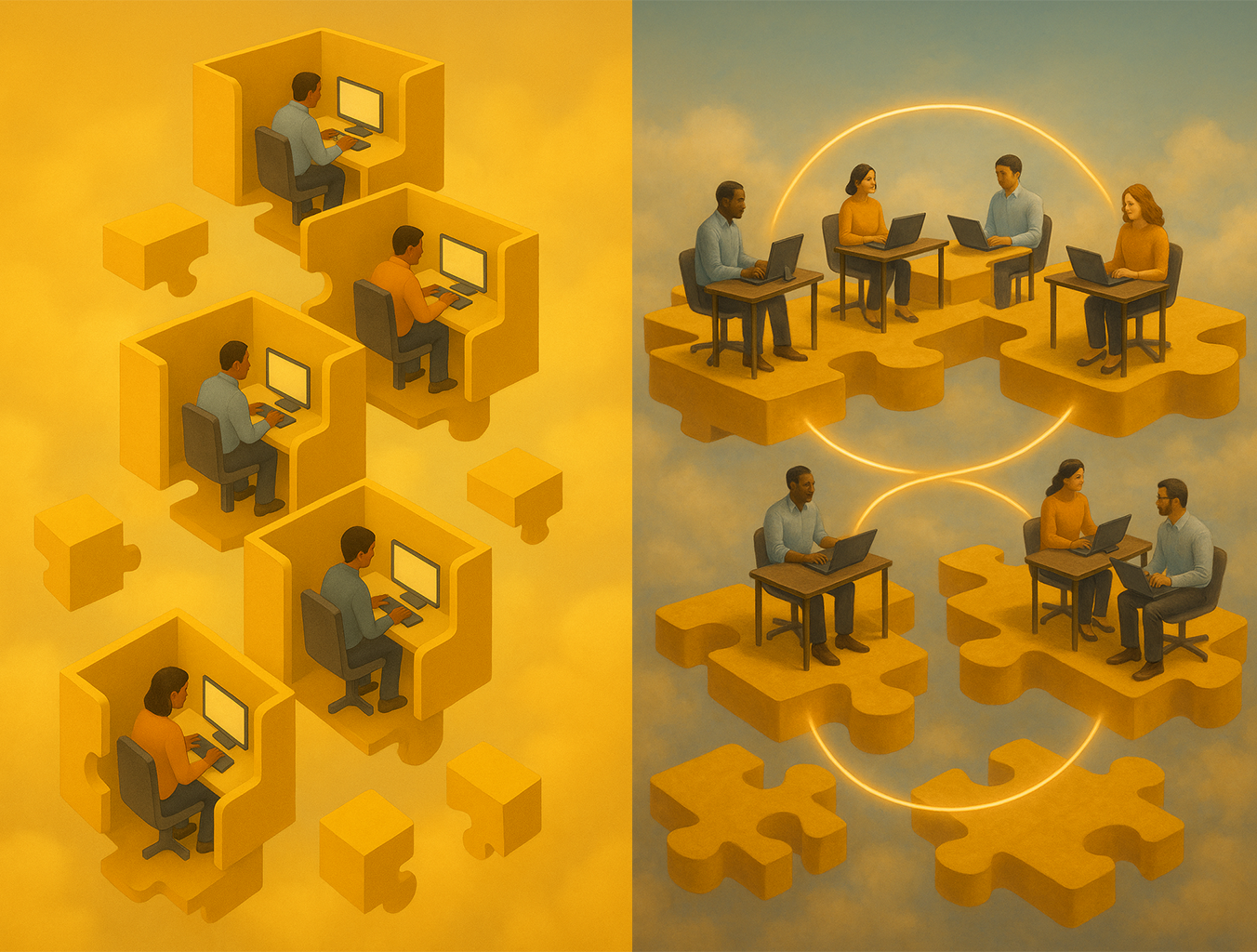
You have invested in capability building. Culture transformation. Leadership development. Yet the organization still struggles to adapt at the speed your strategy requires. The problem isn’t a lack of commitment or talent. It’s that you are using industrial-era tools to solve ecological-era problems.
Industrial thinking optimizes for predictable outputs. Ecological thinking is designed for adaptive capacity. One measures what was produced. The other measures what becomes possible.
The future belongs to organizations that understand the difference.
What We Inherited From the Industrial Era
Frederick Taylor gave us efficiency. Henry Ford gave us standardization. Management science gave us control systems. These were appropriate for the manufacturing-era challenges of coordinating physical labor, minimizing waste, and achieving consistency at scale.
But knowledge work doesn’t behave like assembly lines. Human learning doesn’t respond to efficiency pressures. Adaptation can’t be controlled from the top. Yet our organizational infrastructure, from performance systems to training models to hierarchical feedback structures, still reflects assumptions built for a world of predictable work.
We are running 21st-century organizations on 20th-century operating systems. The mismatch is expensive.
The Shift to Ecological Thinking
Ecological systems do not optimize for a single outcome. They create conditions that make multiple outcomes possible. They do not control components. They design environments that shape emergent behavior.
Education has operated under this model for centuries, often without being explicitly acknowledged. A skilled teacher does not manage performance. They design conditions for growth. They understand that learning is a living system, not a linear process. They know capability emerges from the environment, not from intervention alone.
This is the shift organizational development must make: from intervention thinking to environmental thinking. From measuring activity to measuring capacity. From controlling behavior to designing conditions.
Four Ecological Principles That Reframe Organizational Development
1. Cognitive Load Is a Design Problem, Not a Capability Problem
When teams underperform, we diagnose skill gaps. We rarely diagnose system friction.
Ecological thinking asks: What is the cognitive cost of success here? How much mental effort does our environment require before people can even reach the real problem? Are we asking teams to solve challenges, or are we first asking them to solve the system so they can get the challenge?
Teachers design lessons to maintain a manageable cognitive load. They chunk complexity. They sequence learning. They remove unnecessary friction. Not to make learning easier, but to make it productive.
Organizations rarely do this. Instead, they add tools, steps, and expectations, then question why people cannot absorb it all.
The ecological reframe: Underperformance often signals poor environmental design, not poor talent.
Executive implication: Before adding training, audit cognitive friction. What could be removed, clarified, or sequenced differently to unlock capability?
2. Feedback Is Environmental Infrastructure, Not a Management Event
In industrial models, feedback is a quarterly conversation. A performance review. A ritual of evaluation.
In ecological systems, feedback is continuous sensory information that shapes behavior in real time. It is not a judgment delivered later. It is guidance embedded in the work.
Educators understand this deeply. Feedback must be immediate, specific, and instructional. It must be close enough to the moment of action to shape the following action.
Corporate feedback rarely meets this standard. It is late, abstract, and disconnected from the work. It measures performance. It seldom builds it.
The ecological reframe: If feedback does not change behavior, it is not feedback. It is documentation.
Executive implication: How could feedback become environmental, built into workflows, peer interactions, and system design, rather than episodic?
3. Growth Requires Adaptive Scaffolding, Not Standardized Expectations
Industrial systems assume uniform inputs create uniform outputs. One training. One competency model. One development path.
Ecological systems adapt to readiness. They offer structure when needed and remove it when capability emerges. They understand that development is non-linear and that timing is more important than content.
Education calls this scaffolding. Business rarely has a word for it. Yet high performers can all name the moment someone gave them a challenge that matched their edge: hard enough to stretch, structured sufficiently to succeed.
Most organizations either over-support or under-support. They treat development as a program, not as a dynamic relationship between challenge and readiness.
The ecological reframe: Growth happens at the edge of capability, supported at the right time.
Executive implication: Do you assess readiness, not just performance? How does challenge adapt as capability evolves?
4. Engagement Is a System Condition, Not an Individual Attribute
Industrial models treat engagement as a trait. Something people either have or lack. Something measured through surveys and influenced through programs and perks.
Ecological thinking treats engagement as emergent. It arises when three conditions exist: competence (I can succeed here), autonomy (I have agency), and connection (I matter here).
When these conditions are present, engagement follows. When they are absent, no incentive program to compensate.
This is why education focuses on the learning environment, not on motivating individual students. Motivation is an outcome of environmental design, not personal willpower.
The ecological reframe: Disengagement is usually a system signal, not a people problem.
Executive implication: Before diagnosing low engagement, audit environmental conditions. Do people feel capable, autonomous, and connected?
What Gets Measured in an Ecological System
Industrial metrics measure throughput, including projects completed, goals achieved, and the speed of execution.
Ecological metrics measure capacity: How adaptable is the organization? How well does the system support learning? How quickly do teams recover from setbacks? How effectively does knowledge transfer across boundaries?
The invisible architecture of learning determines long-term performance: cognitive load, confidence, feedback quality, readiness alignment, psychological safety, and learning velocity. Yet most organizations have no instrumentation for any of it.
We track lagging indicators of output. We ignore leading indicators of capability.
What changes when you measure ecologically:
Decision quality over decision speed
Learning velocity over task velocity
Knowledge transfer over individual heroics
Adaptive range over operational consistency
Recovery patterns over error counts
These metrics predict whether the organization can evolve in tandem with its environment, rather than falling behind it.
What This Looks Like in Practice
Ecologically designed organizations do not look like traditional companies:
Work is designed to reduce unnecessary friction before demanding higher performance
Feedback is frequent, specific, and embedded in workflows
Challenge is calibrated to readiness, not imposed uniformly
Failure is treated as information, not incompetence
Collaboration is structured through the environment, not forced through mandates
Learning happens inside the work, not only in training
Progress is measured through capability growth, not just activity completion
This is a shift from managing people to designing conditions that make better behavior almost inevitable.
The Strategic Implication
You cannot build an adaptive organization using industrial infrastructure. You cannot ask for learning while designing for compliance. You cannot expect transformation solely by optimizing for efficiency.
The organizations that will outperform the next decade will not have better talent. They will have better learning environments. They will build architectures where growth, adaptation, and the circulation of insight are the default patterns.
This requires a shift in how executives think about organizational development:
Not “How do we train people?” but “How does our environment teach?”
Not “How do we motivate performance?” but “What conditions support engagement?”
Not “How do we manage change?” but “How do we design for ongoing adaptation?”
The Real Question
Education has spent centuries understanding how humans grow. It has refined models for motivation, scaffolding, feedback, developmental readiness, and sustainable learning. It has always seen learning as a living system.
Business now faces the same challenge. The complexity of modern work demands organizations that learn as fast as the world changes. The principles already exist. The question is not whether ecological design works.
The question is whether leadership is willing to stop managing individuals and start architecting environments that let capability emerge.
Others in this series:
The Power of Design in Shaping High-Trust Organizations: How coherence in systems, workflows, and experiences unlocks stronger relationships and drives strategic growth.
The Business OS Upgrade: Moving from Control to Collaboration: Why the future of work depends on shared power, relational intelligence, and systems that thrive through connection, not command