
What We Mistake for Performance
Why endurance, not efficiency, defines modern leadership

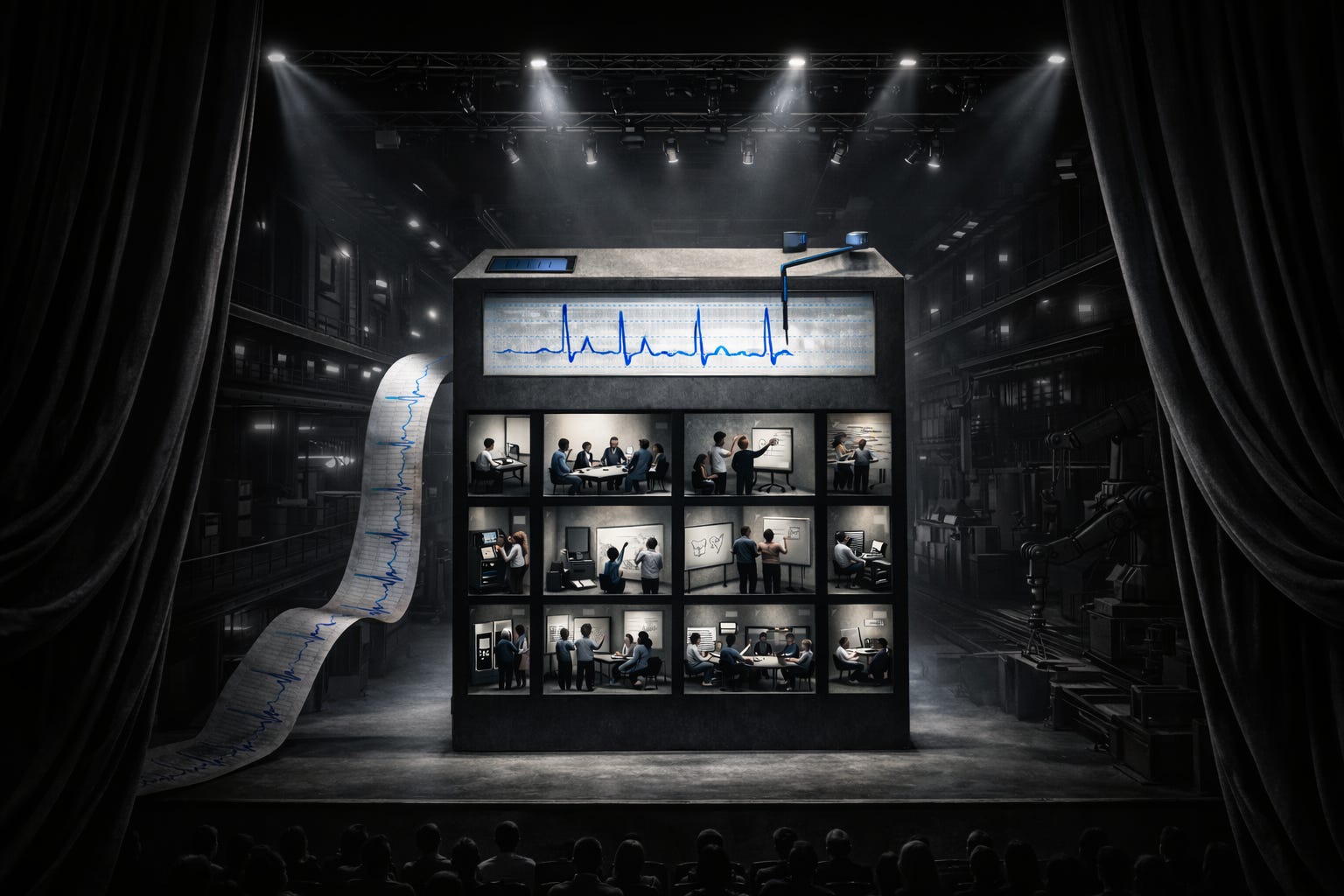
Most leadership practice is built around a narrow definition of performance: speed, output, utilization, predictability. We celebrate leaders who deliver quarterly results and keep systems running without disruption. These signals feel concrete, measurable, defensible.
They are also terminal.
The question is not whether you can perform this quarter. It is whether you will still be competing in five years, or whether more adaptive organizations will have taken your place.
What often passes for performance today looks impressive from the outside. Dashboards glow. Meetings stay full. Teams stay busy. But activity is not vitality. Visibility is not health. Many organizations are staging performance rather than sustaining it.
The Problem Is the Model
Leadership practice has not evolved at the same pace as the systems leaders now run. Despite operating in environments defined by complexity and rapid change, most organizations are still managed using industrial-era assumptions. We plan as if outcomes are predictable. We measure as if performance is linear. We intervene as if control produces stability.
This machine logic feels practical. It offers clarity, authority, and order.
It also produces organizations that cannot endure.
Organizations are not neutral containers for work. They are systems shaped by trust, fear, incentives, narratives, and power. Culture determines how decisions are made under pressure. Psychological safety affects how quickly risks surface. Unresolved tension creates drag long before it appears in metrics. Energy and morale compound just as surely as technical debt.
Yet leadership responses continue to focus on visible outputs rather than system health.
When delivery slows, pressure increases.
When collaboration breaks down, structures are reorganized.
When engagement drops, programs are introduced.
These interventions produce short-term compliance, which is mistaken for performance. Over time, the system weakens. Adaptability declines. Talent leaves. Learning slows.
Why Efficiency Is Not Performance
Efficiency thinking works in closed systems with stable inputs and repeatable outputs. Toyota’s manufacturing system succeeded precisely because the variables were controllable: standardized parts, predictable processes, and clearly defined quality gates.
Modern organizations are different. They are open systems operating across shifting markets, distributed teams, ambiguous incentives, and accelerating technological change.
In this environment, optimizing for the wrong signals creates systemic damage.
High-growth technology companies that prioritized velocity without investing in organizational health eventually hit a ceiling. When market conditions shifted, they could not adapt. Institutional knowledge had walked out the door. The trust required for rapid pivots had eroded. Rework costs consumed the margin created through speed.
Professional services firms that optimized billable hours lost more than senior talent. They lost judgment, continuity, and client trust. Competitors with stronger retention and healthier cultures captured the complex, high-value work.
These organizations were performing by traditional measures right up until they lost strategic position.
The gap between efficiency and endurance only becomes visible when conditions change. By then, rebuilding takes years, and you are no longer in the game.
What Endurance Actually Means
Endurance is not survival. Survival is passive. Endurance is the capacity to sustain performance while adapting to changed conditions without systemic breakdown.
Operationally, endurance shows up in a small number of structural capabilities.
Decision quality under sustained ambiguity
In hierarchical, siloed organizations, decisions move slowly up chains of approval and fail when conditions change because context was never shared, only conclusions. Enduring organizations invest in distributed decision-making. People understand not just what to do, but why. The mission, constraints, and trade-offs are visible. Decisions are made closer to the problem and remain sound as variables shift.
Institutional knowledge that moves with the organization
When knowledge lives in individual heads or protected fiefdoms, every departure or reorganization resets capability. Enduring organizations invest in cross-training and transparency. Context is documented and shared. New leaders become effective quickly because knowledge compounds rather than fragments.
Recovery through transparency, not blame
In low-trust environments, failure triggers defensive behavior. Information is hidden. Accountability becomes punishment. Recovery slows because acknowledging problems is risky. High-trust organizations surface issues early. Resources are reallocated quickly. Energy goes to correction rather than protection. Time to recovery becomes a competitive advantage.
These capabilities are not cultural aspirations. They are structural outcomes of deliberate choices about transparency, decision rights, and what leadership consistently rewards.
The Forces Working Against You
Most leaders sense this gap. Fewer feel positioned to act on it.
Markets reward predictability. Boards expect near-term results. Investors demand certainty in uncertain systems. When competitors operate within the same mechanical logic, deviation feels risky.
These forces are not irrational. For actors with short time horizons, machine logic can be effective. The question is whether your time horizon aligns with quarterly optimization or long-term position.
If you are building for endurance, the current model will work against you until it no longer works for anyone. When that moment arrives, rebuilding capacity takes years.
When Endurance Is Not the Goal
Endurance is not the right objective for every organization.
Some companies are intentionally built for short horizons. Startups designed for acquisition optimize for speed, narrative momentum, and exit timing. Private equity portfolios often prioritize efficiency, cost extraction, and near-term multiple expansion. In these contexts, machine logic is appropriate. The system is not meant to endure. It is meant to be transferable.
Problems arise when organizations claim to be building for the long term while structurally optimizing for short-term outcomes. This mismatch erodes trust and hollows out capability. Teams are asked to invest emotionally in a future the operating model is not designed to reach.
Clarity matters.
If your goal is acquisition, be honest about it and optimize accordingly. Do not borrow the language of endurance while practicing extraction.
Endurance leadership becomes necessary when the organization intends to remain responsible for its outcomes over time. Public companies, mission-driven enterprises, platforms that depend on trust, and institutions expected to outlive their current leadership cannot rely on efficiency alone.
Endurance is not a moral stance. It is a strategic choice.
The question is whether your ambition matches your operating model.
If you are building to sell, optimize for speed.
If you are building to last, efficiency will not be enough.
What Changes
Patagonia embedded environmental commitment into its governance rather than treating values as aspiration. In 2022, founder Yvon Chouinard transferred ownership to a trust and nonprofit designed to ensure profits fund environmental action rather than shareholder extraction.[1]
This was not idealism. It was structural design. Patagonia still manages cost, supply chains, and performance rigorously. The difference is that efficiency serves coherence rather than overriding it. Employees understand the logic behind trade-offs, which reduces friction and increases resilience.
The distinction is time horizon.
Machine leadership optimizes the quarter.
Endurance-oriented leadership builds what compounds.
Redefining What You Measure
Traditional metrics still matter: revenue, margin, velocity, quality. But they only tell you how the system performed, not whether it can keep performing.
Endurance requires a smaller set of complementary signals that reveal system health.
Trust velocity reflects how quickly trust forms around new leaders, teams, or initiatives. Faster trust formation surfaces risk earlier and reduces hidden drag.
Transparency flow captures how quickly material information moves across the organization without being forced by hierarchy. Strong flow exposes problems before they become crises.
Recovery time measures how long it takes to stabilize after failure or disruption. Faster recovery signals adaptive capacity. Slow recovery reveals fragility.
These indicators are harder to quantify than traditional KPIs. They are also far more predictive of long-term competitiveness.
Healthy organizations resemble healthy bodies. They surface issues early. They recover quickly. They adapt without panic. Trust and transparency are not soft traits. They are structural forces with material impact on performance over time.
The Risk You Are Actually Taking
Reorienting toward endurance carries real risk.
Decisions may move more slowly as shared context is built. Peers operating in efficiency-first models will question your judgment. Boards optimizing for short horizons may resist.
You may also get fired.
If your board is optimizing for the next eighteen months and you are building for the next five years, the misalignment will surface. This is not a flaw in the approach. It is clarity about whose time horizon you are serving.
What you gain, if you survive the transition, is staying power.
Fewer costly reversals.
Lower attrition of critical talent.
Faster adaptation when conditions shift.
Organizations capable of thinking, not just executing.
Every leadership model involves trade-offs. The question is which trade-offs position you for the next decade, not the next quarter.
Why This Matters Now
Market volatility, technological acceleration, and stakeholder scrutiny are intensifying. These conditions reward organizations that can adapt without breaking.
Some will dismiss this as philosophical. The counterargument is empirical. Organizations that build for endurance often outlast peers who optimize for conditions that no longer exist.
Your competitors may outpace you if you abandon discipline. They will not outpace you if you expand what discipline means.
Leadership today is less about tighter control and more about designing conditions where systems can sustain performance over time.
If leadership feels harder than it used to, it is not because leaders are failing.
It is because what we call performance no longer produces endurance.
And that is a choice we can unmake.
Sources
[1] Patagonia Founder Gives Away Company to Fight Climate Crisis
David Gelles. The New York Times. September 14, 2022.
Other readings that inspired this essay
Thinking in Systems: A Primer
Donella H. Meadows. Chelsea Green Publishing. 2008.
A foundational text on systems behavior that explains why optimizing parts often degrades the whole and why endurance depends on feedback loops, not control.
The Fifth Discipline: The Art and Practice of the Learning Organization
Peter M. Senge. Doubleday. 1990.
Introduced systems thinking into organizational leadership and made the case that learning capacity, not efficiency, determines long-term viability.
Seeing Like a State: How Certain Schemes to Improve the Human Condition Have Failed
James C. Scott. Yale University Press. 1998.
A powerful critique of high-modernist control systems that shows how legibility, standardization, and efficiency-driven design undermine resilience and local intelligence.
Good Strategy Bad Strategy: The Difference and Why It Matters
Richard Rumelt. Crown Business. 2011.
Clarifies why strategy is about confronting reality and building advantage, not performing competence through goals, metrics, and slogans.
Team of Teams: New Rules of Engagement for a Complex World
Stanley McChrystal, Tantum Collins, David Silverman, and Chris Fussell. Portfolio. 2015.
Demonstrates how distributed trust, shared context, and decentralized decision-making outperform hierarchical control under conditions of complexity.