
The Two-Clock Problem
Why short-term efficiency is starving long-term judgment

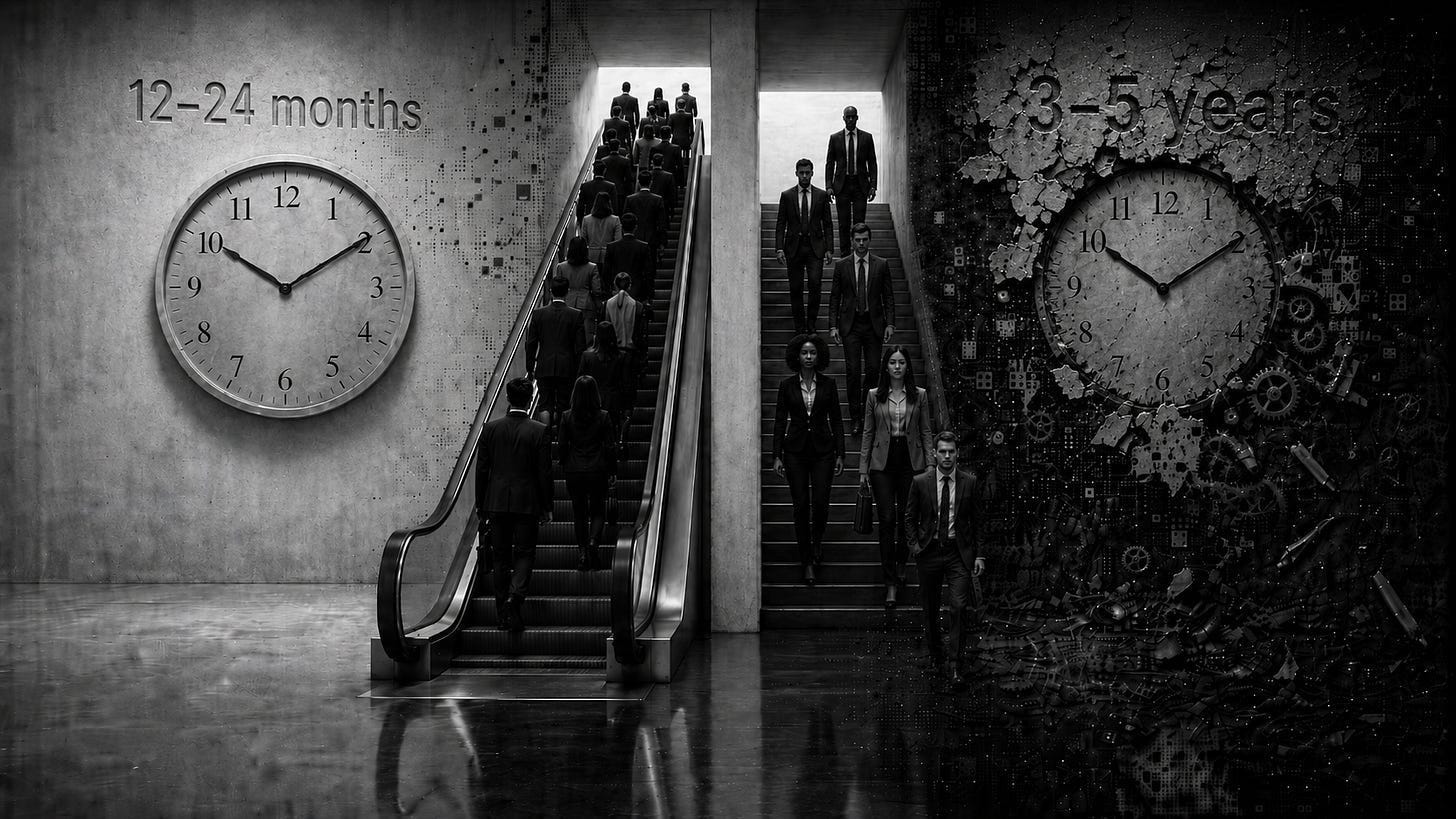
Every organization that scales efficiency is making a trade it cannot fully see. One clock tracks how quickly things get cheaper, faster, and more accessible. The other tracks what happens to judgment as that efficiency compounds. The first moves immediately and gets measured. The second runs quietly and shows up years later, when it is much harder to fix.
In the 1970s, America made that trade in food. Not in a single decision, but through thousands of choices inside a system optimized for scale. Cost, consistency, and shelf life won. Cooking knowledge stopped transferring. The results looked like progress: calories became cheap, abundant, and convenient, with more than 50% of the average U.S. diet now coming from ultra-processed foods. The cost appeared later, as the capability to sustain healthy nutrition eroded and diet-related disease rose across the population.
We are doing this again, not to bodies this time but to minds.
The Two Clocks
In my last essay, I argued that AI is accelerating the disappearance of the path to expertise. The early repetitions that once built judgment- rough drafts, routine reviews, small corrections, low-stakes mistakes- are being stripped away in the name of efficiency. These were never just tasks. They were how people learned to think.
The performance clock closes in twelve to eighteen months. It aligns with promotion cycles, budget reviews, and quarterly plans. It measures what organizations can see: throughput, error rates, time to delivery, revenue per employee. On this clock, AI looks exceptional.
The judgment clock closes in five to seven years. It has no dashboard. It runs quietly as people move into roles that require discernment. It does not measure how quickly someone produces an answer, but whether they can recognize when that answer is wrong.
Economist Erik Brynjolfsson and his colleagues describe the Productivity J-Curve with transformative technologies: early gains are uneven while organizations adapt, often masking deeper structural shifts. We are seeing the visible side of that curve now. The less visible side is the erosion of judgment accumulating in the background.
Organizations are optimized for the first clock and largely blind to the second. The result is predictable: visible gains now, invisible deficits later.
What the Gap Looks Like
In law and consulting, junior roles were never really about the work product. Document review and research memos felt like drudgery, but they built calibration. You learned what a bad contract looked like before negotiating one. You saw enough edge cases to develop pattern recognition before any of them were yours to own.
AI now does that work faster and cheaper. The performance clock improves immediately. As one senior partner put it: the work is fine, but I can’t tell if they actually think. I used to know who had instincts. Now I only find out when something goes wrong.
Atul Gawande has described expertise in medicine as something built through repeated exposure to uncertainty, error, and supervised practice. That same dynamic is now under pressure. AI systems can handle more of the early analysis, but they do not replace the experience of being wrong and learning from it. As one attending physician put it: residents arrive sharper on paper, but they have not been wrong in low-stakes ways often enough to build judgment.
The performance clock makes professionals faster at what the AI already understands. The judgment clock determines whether they can respond when it does not, when the case falls outside the training data, and judgment is the only thing left.
Why Organizations Keep Doing It Anyway
The promotion cycle rewards what it can see. An employee using AI produces cleaner analysis faster; her manager concludes the system is working. What neither sees is what has been removed: the internal struggle that builds judgment. She refines outputs, but does less of the thinking that produces them. Years later, the organization discovers it has promoted people who are fluent in answers but thin in discernment.
This is not a motivation problem. It is a design problem. Call it tenure arbitrage. The performance clock pays out within a review cycle. The judgment clock defaults years later, often under different leadership. The person who captured the gain is rarely present when the gap appears. The incentives are not just misaligned. They are inverted.
Shoshana Zuboff’s work on surveillance capitalism describes how systems convert human experience into measurable outputs. Inside organizations, the dynamic is similar: what can be measured is optimized, and what cannot is neglected. Judgment is not deliberately removed. It is externalized.
The system is behaving rationally. Like the food system before it, it is optimizing for what it can see, while the long-term capability it depends on erodes out of frame.
What Can Actually Be Done
Before automating a task, ask what capability it builds. Some work is purely productive. Some is developmental. The difference matters.
Donald Schön described professional expertise as reflection-in-action: the ability to think while doing the work. When AI removes the early repetitions, it also removes many of the moments where that reflection forms.
A simpler set of questions is enough: What judgment does this task build? If AI takes it over, what repetition disappears? Where will that repetition be rebuilt?
Designing for this means replacing, not just removing. Structured case reviews. Simulations that expose failure modes before the stakes are high. Requiring people to write the dissent, not just accept the recommendation.
It also means tracking what most organizations ignore: the rate of principled disagreement. How often do people challenge or qualify AI outputs? If that rate drops to zero, the judgment clock has stopped.
The Choice You Are Actually Making
Large-scale capability loss does not announce itself early. The signals are easy to dismiss: performance looks strong, outputs are improving, and dashboards tell a coherent story. The underlying erosion takes longer to see.
We are at the early stage of that process. The system is working as designed. The question is whether we leave it that way.
Before you automate the work, ask what it was teaching. Before you celebrate the output, ask what capability may have been bypassed. Before you remove the repetition, decide where to rebuild judgment.
Not resisting AI. Designing the conditions under which people can still become wise.