
Stop Automating the Easy Stuff
AI can expand judgment, or quietly erode it


Technology has always advanced by absorbing what constrained us. The steam engine took on physical limits and gave us mobility. Electricity took on darkness and gave us time. Computing did not just make math faster. It absorbed the repetitive work of storing, processing, retrieving, and comparing information, allowing organizations to operate at a scale human memory and paperwork could never support.
At their best, these shifts made parts of life less brutal, less limited, and more expansive.
Then digital complicated the deal, and in too many workplaces, broke it.
Digital did not just change how we work. It changed what we practice. Every day, for twenty years, knowledge workers have practiced scanning, clicking, reacting, and moving on. They have not practiced sitting with a question they cannot answer. That is not a design flaw. That is the design.
Digital rewarded the quantified, the optimized, the legible. It sidelined the capacity to see how parts connect, what context changes, and what a number cannot tell you. We got better at breaking things down. We got worse at holding them together.
It gave us a faster, more superficial connection and took away solitude. It gave us information and took away the patience to sit with a hard problem long enough to actually understand it.
A designer learned through materials, constraints, and production realities before touching a layout. A merchant used to walk the floor, talk to customers, and carry the contradiction between what the data said and what they saw in real life. Those frictions were not inefficiencies. They were how people learned to think.
Every previous breakthrough changed not just the tools but the entire operating system of work. The Industrial Revolution moved work out of homes and into factories. It reorganized how people coordinated, where authority lived, and what a working day meant. The technology and the human system around it transformed together.
Digital never made that trade. We moved into open offices, added screens, and handed everyone a device. But we never renegotiated the relationship between humans and machines. We just gave the assembly line a user interface. The tools changed. The underlying logic did not. Humans were still components. The machine just got faster, and the component got a Slack notification.
And nobody called it a design failure, because the metrics looked fine.
AI is about to run that same play, at a scale that will make the digital era look like a rehearsal. The difference is we no longer have the excuse of not knowing how this ends.
The Hidden Cost of Treating Humans Like Machines
The public conversation about AI is still fixated on the wrong threat.
Will it replace designers, analysts, researchers, and managers? Maybe, in some places, for some kinds of work. That question is worth asking. But it is not the one that should keep leaders up at night.
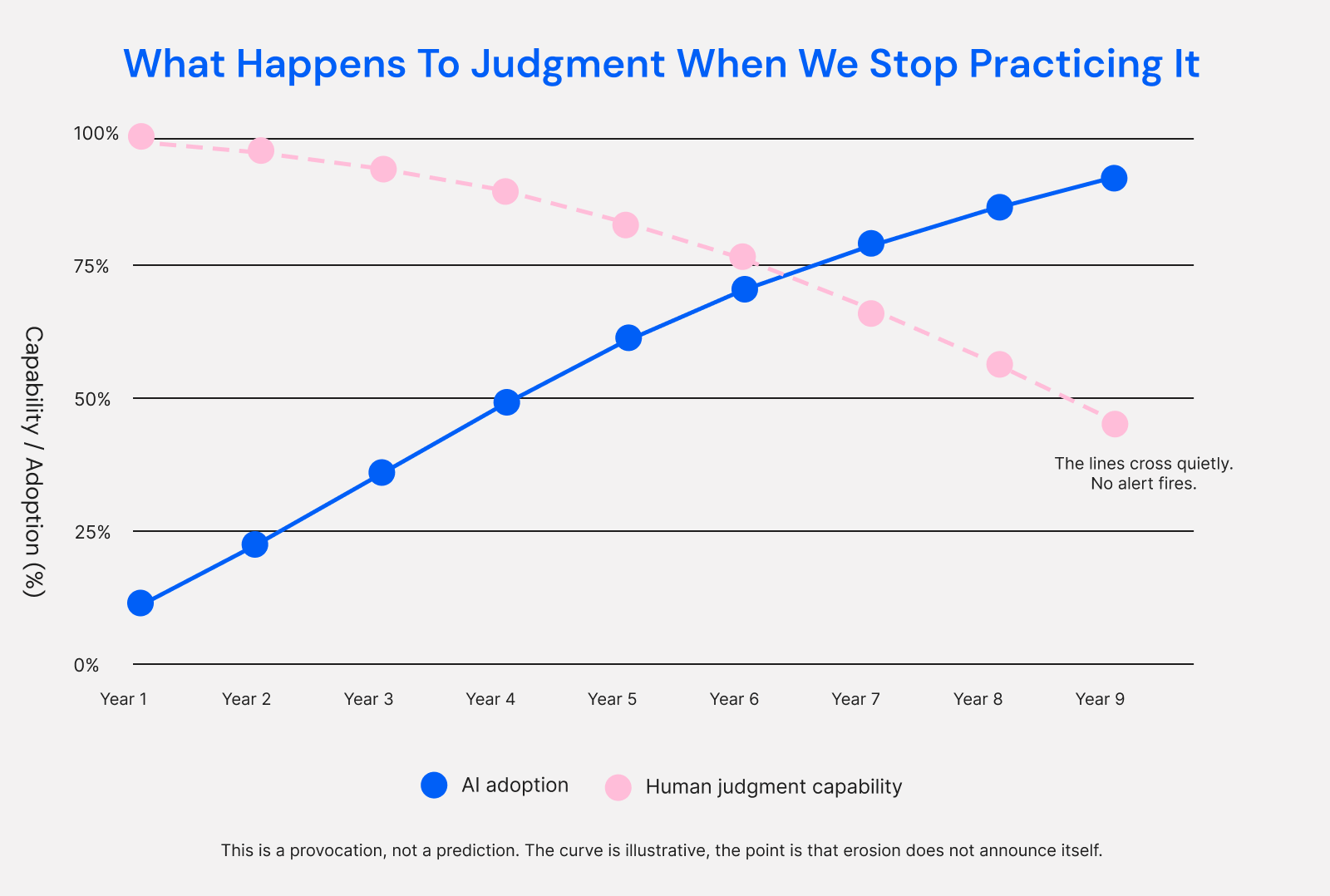
The more consequential risk is not that humans disappear from the system. It is that humans remain in the system and slowly become less capable within it.
AI becomes dangerous not only when it replaces human thinking, but when it makes human thinking feel unnecessary. The recommendation is already there. The summary is already written. The choice has already been shaped before a person enters the room. People may still be involved, but they are no longer in the lead. They are asked to approve what the system has already framed, rather than shape the decision from the start.
What atrophies is not the job title. It is the capacity underneath it. The ability to interpret a signal that does not fit the pattern. To sit with a contradiction long enough to understand it. To form a point of view without waiting for the model to go first. To notice what the data is not saying.
That is where judgment lives. And judgment is not a feature you can restore with a prompt. It is built through repetition, friction, and the slow accumulation of being wrong in low-stakes situations often enough to get better at the high-stakes ones.
AI will not dramatically remove that practice. It will make it optional. And in organizations, optional skills rarely survive the next planning cycle.
If you just thought, “That is a problem for other organizations, not mine,” take that thought seriously. Not because it is wrong, but because that exact confidence, that your culture will protect judgment, is how atrophy becomes invisible. The most dangerous automation is not the one you fight. It is the one you do not notice because you assume your rituals are strong enough.
When did you last memorize a phone number? Not save a contact. Memorize. When did you last rehearse a number in your head while walking to the phone? That skill did not disappear because it was useless. It disappeared because the machine made it optional. Many people do not notice until the system is unavailable and the underlying skill is suddenly needed.
Now apply that to product judgment. Customer understanding. Ethical reasoning. Strategic thinking. What is the version of judgment you need to protect?
The Question Leaders Are Not Asking
Most AI conversations start with: " Where can we use AI? That is not the wrong question. It is an incomplete one.
The more important question is: what human capabilities are we willing to let atrophy?
Every time you automate a task, decision, or recommendation, you are not just saving time. You are deciding whether the people in your organization will continue practicing the capability that was once developed there.
If AI writes the first draft, who still learns to structure an argument? If AI summarizes the research, who still learns to sit with complexity? If AI recommends the decision, who still learns to weigh competing truths?
Most organizations are not making these choices consciously. They are defaulting to efficiency. And efficiency is not neutral. It shapes what people practice, what they value, and what they slowly stop knowing how to do.
Not Everything Should Be Automated at the Same Speed
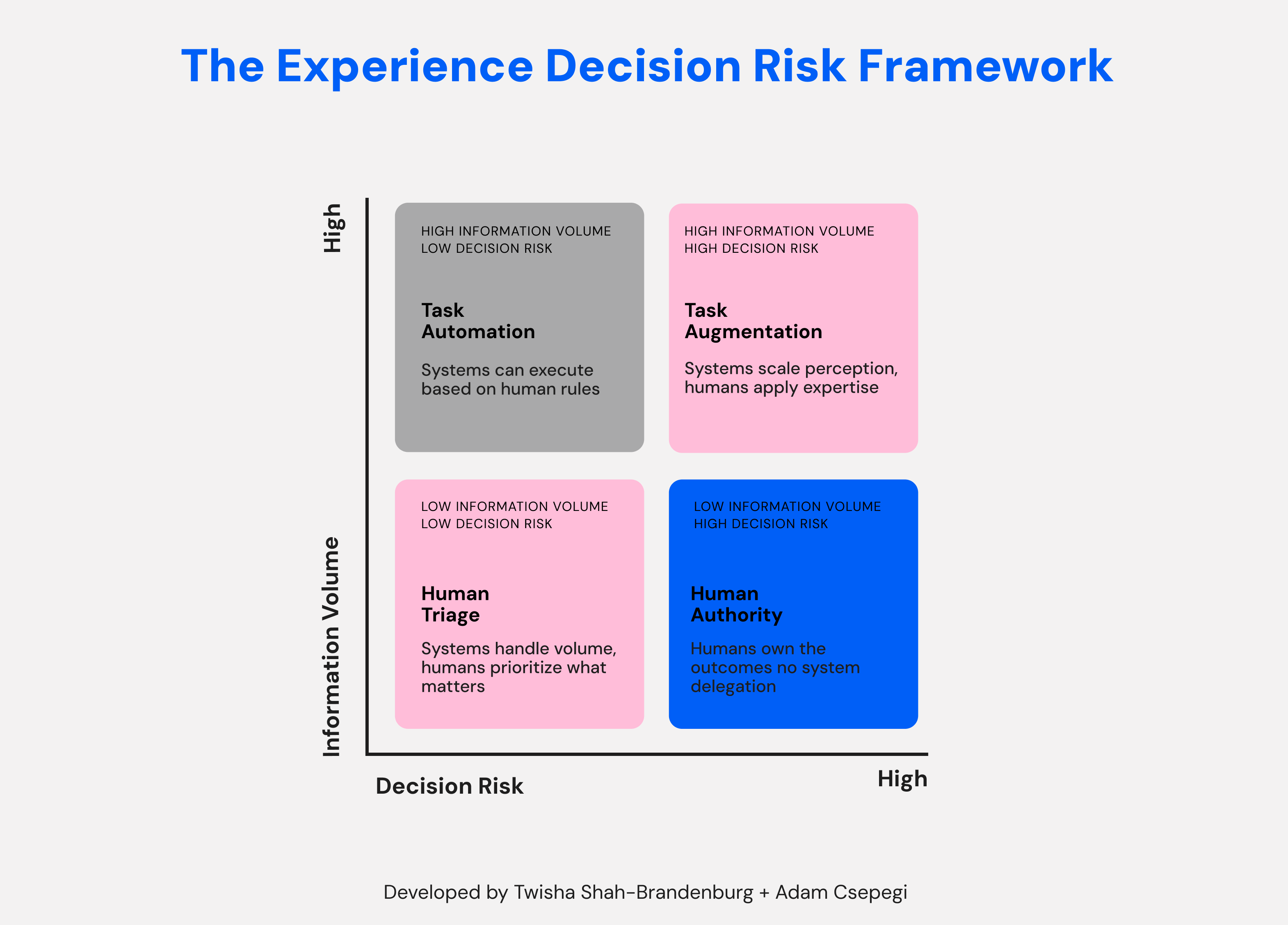
Not every decision should be automated at the same speed. Some decisions are high-volume and low-risk, where automation makes sense. Some are high-volume and high-risk, where AI should expand what humans can see, but not replace the call. Some decisions require triage because the signal is buried in noise. And some decisions should remain firmly human because the consequences require ownership, context, and accountability.
Most organizations are collapsing these situations into one default: automate wherever possible. That is not a strategy. That is how you end up with fast decisions and deteriorating capability.
Where Leadership Fits
Leadership has always been about more than setting direction. At its best, leadership shapes how people understand, decide, coordinate, and act inside systems. Leaders determine what gets measured, where authority lies, how tradeoffs are made, and which human capabilities are strengthened or weakened over time.
That role is urgently needed now because AI is not only changing the tools people use. It is changing who acts first, who sees what, who decides, who reviews, who owns the outcome, and who absorbs the consequences when something goes wrong.
That is not an interface problem. It is both a leadership problem and a decision-architecture problem.
If leaders do not intentionally claim this space, AI systems will be built primarily around technical feasibility, operational efficiency, and measurable throughput. Those things matter, but they are not enough. A faster system is not always a wiser one. A more automated organization is not always a more capable one.
The deeper work is designing organizations where humans remain capable of judgment, not passive operators of machine output. That means leaders must decide what should be automated, what should be augmented, what should remain human, and where people still need practice making the calls that matter.
AI will not make those choices. Leadership will.
What the Future Will Reward
The question is not whether AI can do the work. The question is what weakens in the human when it does.
Do we need AI to write every performance review, or do we need it to surface patterns so managers can have more honest, specific, and human conversations? Do we need it to make the call, or to make the caller better informed, more confident, and more accountable? Do we need self-driving cars everywhere, or cars that make drivers more aware, more capable, and safer on the road?
The ambition should not be to remove humans from consequential work. It should be to make humans more capable of doing it. More perceptive. More precise. More creative with the judgment that only comes from actually being in the room, carrying the context, and owning the consequence.
That will not happen by default. It has to be designed.
Every AI strategy is also a human capacity strategy, whether leaders name it or not. Every automation decision is also a capability decision. Every workflow redesign is also a choice about what humans will keep practicing and what they will slowly stop knowing how to do.
Those choices are already being made in roadmaps, pilots, and planning cycles. Most organizations are making them without realizing it.
Convenience is not the same thing as progress. And the difference between the two will not show up on any dashboard until the judgment is already gone.
So here is the question for your next quarterly planning meeting: what decision are you currently automating that you want a human in your organization to still be good at making in five years, not because the AI cannot do it, but because you want them to have practiced?
If you cannot name one, you are not leading an AI transformation. You are running an atrophy experiment.
This essay is the beginning of a larger conversation I’ll be sharing in my upcoming talk, Stop Automating the Easy Things, hosted by ADPList Chicago x NVISIA. If you are thinking about AI, product systems, leadership, design, or the future of human decision-making at work, I’d love for you to join us at nvisia in Chicago. We’ll dig into how leaders can design AI-enabled organizations that make people more capable, not more dependent.