
Hype Has a History
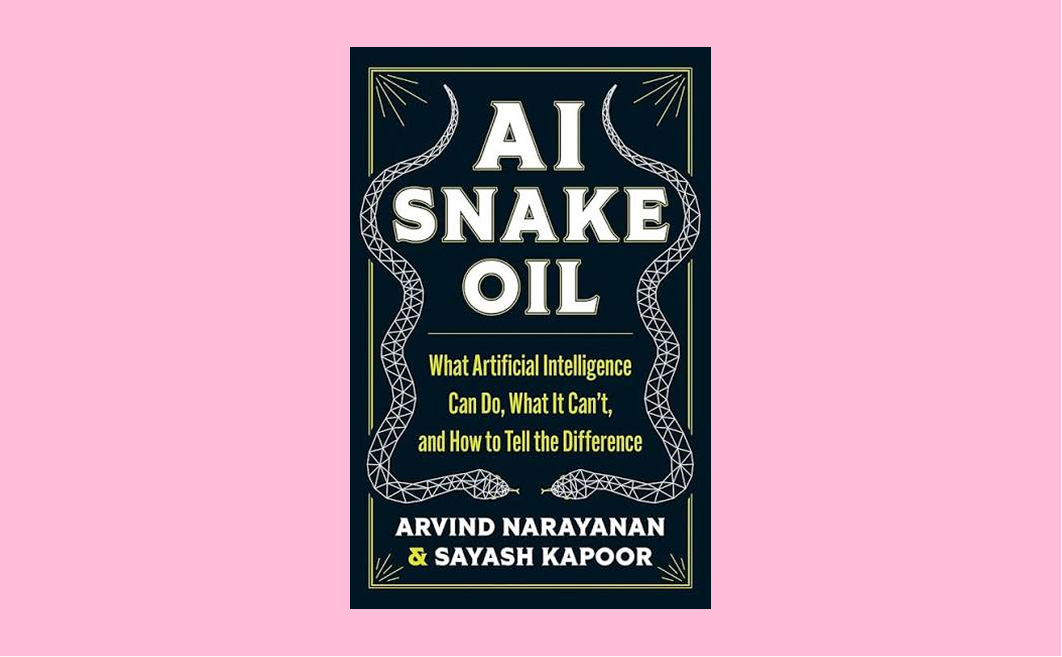
Book review on AI Snake Oil by Arvind Narayanan and Sayash Kapoor

Mental Models Acquired
One way I’ve started measuring whether something was worth reading is simple:
Did it give me language I didn’t have before?
The most durable mental model I took from AI Snake Oil is the distinction between generative AI and predictive AI.
Generative AI creates. It writes, speaks, paints, and composes. When it fails, it produces misinformation or convincing nonsense.
Predictive AI forecasts. It attempts to determine who will succeed, what will happen, and where resources should go. When it fails, those errors shape decisions about people’s lives.
This distinction matters more than most conversations acknowledge. “AI” is often treated as a single category, flattening fundamentally different capabilities and risks.
I suspect I’ll keep using this distinction long after I’ve forgotten the specifics of the book.
What This Book Gets Right
The authors situate today’s AI boom within a longer history of technologies that promised more certainty than they could deliver. Their argument is not that AI doesn’t work—it’s that institutions repeatedly ask these systems to do more than they can reliably support.
What makes the book compelling is its restraint. It acknowledges the real capabilities of generative AI while remaining sharply skeptical of predictive systems deployed in hiring, policing, education, and healthcare.
At its core, this is not a book about AI.
It is a book about claims:
Who makes them, how they are validated, and what happens when statistical outputs are mistaken for judgment.
Skeptic’s Corner
My main critique is one the authors couldn’t fully avoid: the book was written at a moment the technology is outrunning.
Some examples will age. Models are improving faster than the cautionary cases the authors build around them, and readers coming to this in two years may find the specific claims less grounded than the underlying argument deserves.
The generative-versus-predictive distinction is genuinely useful, but agentic systems are already complicating it. A system that reasons, recommends, and acts is not cleanly one or the other. The authors don’t fully reckon with what happens when the boundary moves.
The deeper limitation is structural. This is a book written for skeptics who need permission, not for practitioners who need guidance. If you are already inclined to question AI claims, the book confirms your instincts. If you are inside an organization trying to figure out where to draw the line, you will finish it knowing what to distrust without knowing what to do instead.
That’s a real gap. And it’s not unique to this book. It’s the limitation of the genre.
Top 3 Signals I’m Taking Forward
AI Is Not One Thing
Conversations about AI often collapse radically different systems into one category. The generative vs. predictive distinction helps explain why different applications carry different risks and deserve different levels of trust.Overconfidence Is a Recurring Pattern
The arc of AI is not new. Many technologies have promised objectivity and certainty before their limits became clear. Today’s moment fits a familiar cycle: optimism, adoption, and eventual reckoning.The Hard Problem Is Delegation
Every AI system encodes a decision about what gets automated and what remains human. Organizations optimize for speed and scale, but context, accountability, and judgment are harder to operationalize.
The real design challenge is not the model; it is the boundary.
Signal Worth Your Time?
Yes. Not because it made me more skeptical, but because it sharpened the questions I ask, especially about claims, trust, and where judgment belongs.
Building Judgment
I write about what it takes to lead, decide, and develop people during times of transition
Thanks for the preview before I get to reading this book!
The note about overconfidence, and in particular, the failures around high-stakes AI output (ex: when an important decision hinges upon the AI response/output) makes me think of what kind of guardrails can be put in place to prevent misinformation/non-optimal decisions. Some ideas for past projects have included a confidence "score"/meter so users aren't blindly taking decisions at face value (the consensus app shows meter for strength of evidence, for instance), or giving a different type of output based on how strong (or weak) the AI's "match" between its knowledge base and the user's input (ex: giving multiple options for a user to choose from if it's medium confidence; asking users to re-describe or give more info if it has low confidence).